

To Dream the Impossible Dream
Repairing and moving towards joy. Is it possible?

I spent much of Yom Hazikaron, Israel’s Memorial Day (this was late April, after we’d spent much of March into early April in our shelters and safe rooms), obsessing over how I would feel on Yom Haatzmaut - Independence Day.
After the roller coaster of the last almost 3 years, let alone since Iran 1 and 2 (really Iran 3 and 4, if we count the 1-day missiles-and drones event in April and September ‘24), what was I feeling about my little country, my little Jewish country, Israel?
Yes. Israel. My Jewish country. I’m proud that we are a multi-ethnic place, as well as a place with people from different countries of origin world-wide. I like hearing the different languages of my neighborhood which include lots of French (especially these last few years), as well as Amharic, Arabic, English and much more.
I know there’s so much here that needs repair here, and I’m hopeful, so hopeful, that we will exit this long and protracted wartime period, and enter a time of reconciliation - I have to believe it’s possible - and of a leadership that believes in improving civil rights for all Israelis, and of improved safety for Arab towns affected by racketeering and mob violence. We need a real crackdown on Jewish vigilantism and violence, and find a way forward for the ultra-religious members of our society to accept their responsibilities, including first and foremost, army service, followed by learning and having a trade, so that they don’t ever again freeload on governmental handouts without taking part in societal roles.
And now it’s the 9th of Av, an ancient and yet all-to-current day of Jewish mourning What are we to do with that, I wonder, when all we’ve done is mourn since October 7th, 2023? I’m having a rough time with the ordinary expectations of-the-day, and of digging in and grieving…again.
Back in April, when Ira and I wondered where to go for the ceremonial ending of Memorial Day into Independence Day, we opted for an independent service - meaning not affiliated with any synagogue or prayer style - that’s held in Teddy Park, right in the shadow of the Old City walls.
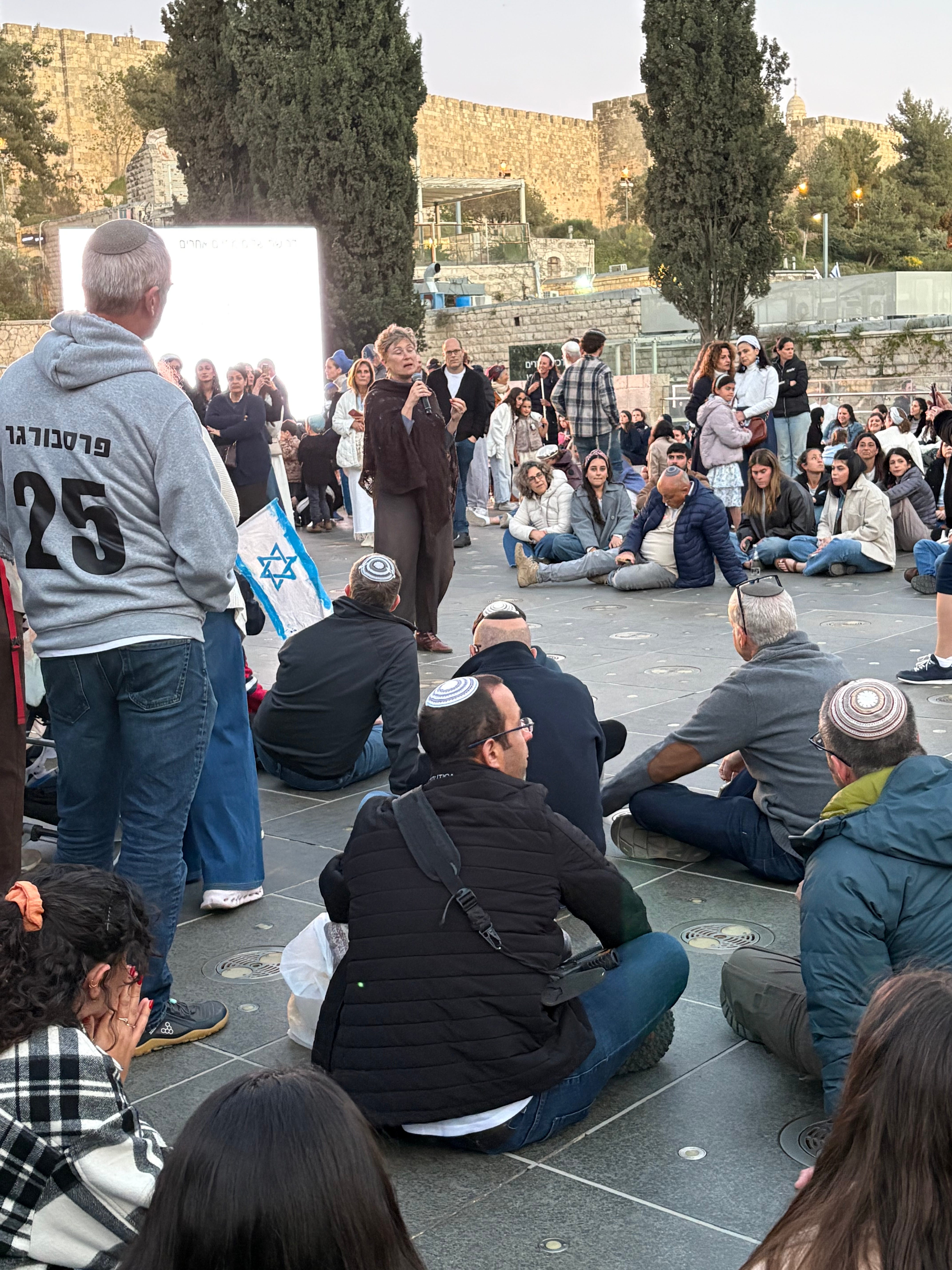
As the day’s sunlight faded, we listened to Iris Haim, mother to Yotam, one of the 3 hostages - Alon Shamriz, Yotam Haim, and Samer Talalka - who were accidentally killed by Israeli forces as they escaped from captivity in December ‘23. Iris, if you’ve never heard her speak is amazing - calm, hopeful, positive. Whether or not she felt rage about her son’s death, she made it her business to speak of peace and healing, even taking the time to visit with those soldiers who felt responsible, reassuring them that she didn’t blame them for what had happened. It takes a lot to say that as a parent, no?
She told of meeting another mother, Dina Guedalia, who’s son, Yosef Malachi Guedalia, was killed in battle on October 7th near Kfar Aza, not far from where Yotam was captured and taken hostage. Iris and Dina both wondered at the timing of Yosef’s death and Yotam’s capture by Hamas forces. They also compared and contrasted the words used for these kinds of deaths. Dina’s Yosef, fell in battle - נפל. Iris’s son, Yotam was kidnapped, or נחתף (being captured was what led to his death). She noted that neither of them liked the expression fallen, that Dina said, “they rise in death” or, עולים. Dina also said, “I’m not a אמא שכולה, a bereaved mother, I’m an, אמא שכולה טוב, a mother to whom all is good.” Words matter of course.
This was the part that blew my mind. Iris described that before October 7th she never knew a religious person, or had ever entered a synagogue. Ever. Until she met Yosef’s mother Dina. Meeting Dina helped her find some connection to faith, an idea that had never really been of importance in her life. In closing, Iris said, “we should be proud of our country, we deserve that feeling, that idea.”
We moved to the prayerful part of the evening, which felt pretty emotional, especially during the prayer for the State and its soldiers, as I stood next to my friend Karen, who as usual, had children in reserve duty - 3 out of 5 of them. Sorry, not children, these are adults, some of whom have left wives and children, jobs and schoolwork, to continue to serve endlessly. The hit on people’s family lives and their marriages hasn’t been simple.
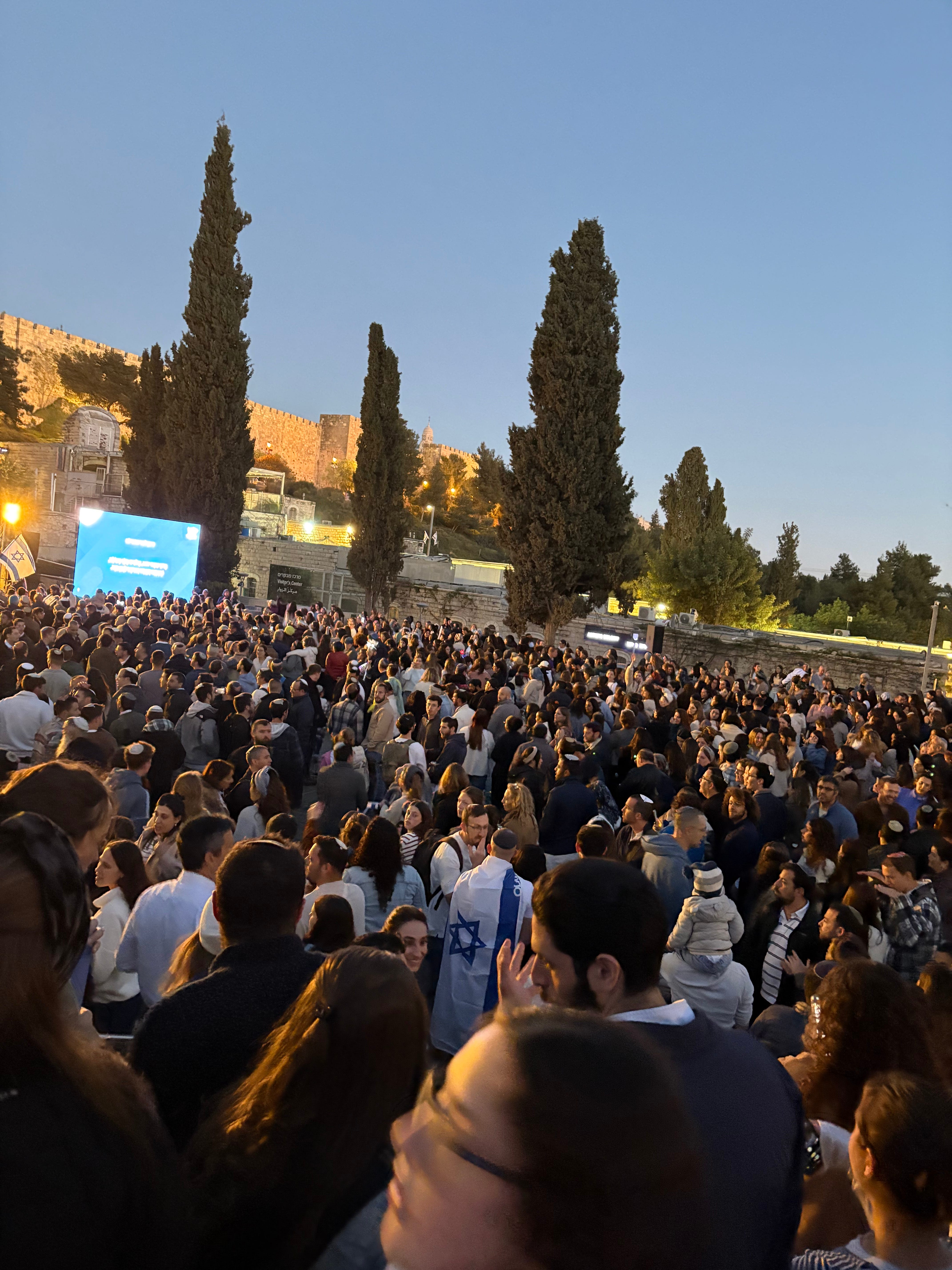
We sang “זֶה הַיּוֹם עָשָׂה ה', נָגִילָה וְנִשְׂמְחָה בוֹ,” or, “This is the day G-d made, let’s be joyous and happy,” to one of Akiva’s favorite tune, “Ve’hi Sheh’amda.” Composed by Yonatan Razel (words from the Passover Seder) it was popularized by singer, Yaakov Shwekey, who has a huge following, especially in the religious world.
Then we actually sang “Ve’hi Sheh’amda,” which was just overwhelming. I thought to myself, sometimes it’s just easier to believe in all of it. You know, G-d, or whatever higher forces in the world that might exist. That we hope exist. That we pray to, whenever it is that you allow youself to pray, lustily, and with a full heart. All those years in synagogue, Jewish day schools and camps - I do buy into prayer. That is I like gathering and praying, I’m just not sure what it all means. (I wish I could be like Akiva, who sings what he wants to, when he needs to…out loud, especially during quieter prayer moments. He liked the outdoor service - it was perfect for him.)
By that point, we’d moved to Hallel, the celebratory set of prayers said and sung on holidays, including Yom Ha’atzmaut (first in 1948), with its opening blessing as added in by Chief Rabbi Shlomo Goren, in 1974.
I was having a ‘dati leumi’, or a religious Zionist moment. And you know what? It felt good. Damn the torpedoes and full speed ahead.
And for such a moment, what’s the ultimate? The end of this celebratory-over-the-top service, which is like Yom Kippur’s final hurrah at the close of the holiday. The Shema prayer - Hear O’ Israel, the Lord is our G-d, the Lord is One,’ and ‘ה הוא האלוקים,’ The Lord is our G-d.’
And then? The shofar. It gave me the chills. We sang לשנה הבאה בירושלים, next year in Jerusalem, then of course Hatikva, Israel’s National Anthem, and then Ani Ma’amin - I believe - because as Ira noted, you can’t leave out the Mashiach, the Messiah. He’s been really delayed for a long time.
And I thought, living here, it’s like Beijing during the building crazy, with a crane on every corner, and every street ripped out for the light rail, for bike lanes, for new sidewalks, for new traffic circles. It’s a nightmare, and I hope I live to see the city modernized and improved.
But today, I teeter, along with so many, at the top of the crane, wondering what will fall next? More war? More terrible laws? More poverty and lack of opportunity for those in need?
I want to respect for my religious inclinations, and for my religious Zionism, even as I reject those who’ve taken those ideas away from me, with behavior and a kind of life that is antithetical to the dream of a Jewish country. An honorable and democratic country. A peaceful - somehow - country. Thankfully, I’m not alone.
Gotta hope. Gotta believe.
That’s one dream for me this Tisha B’av.