

Language. Why is it Important really?
Speaking nicely and thoughtfully matters more than we think

I’m sure in your prayer community (if that’s your thing), there are never any disagreements between members. Everyone gets along at all times and always uses respectful language towards each other. I’m laughing because sadly, as the sister-in-law of our now, gratefully retired community leader, I regularly heard just a bit more than I wanted to as to what goes on behind the scenes. Conversations that shouldn’t happen at all, or should happen more respectfully. You might wonder, shouldn’t happen at all? Shouldn’t all topics be up for discussion? To which I’d say, maybe…as long as everyone can make an effort to speak nicely.
Back in the day in Brooklyn, we were busy synagogue volunteers and regular-services-attendees, and of course, Ira got asked to join the board but not me. I’d wonder was it because I was perceived of as argumentative? Opinionated? To be fair, I am both but perhaps not any more than some of the other longtime members. I assumed it was because I was often seen as too religiously inclined compared to others, and I’d have pushed us towards things that others considered less critically important. Since our move to Israel, our former community has also shifted, grown, and responded to changing needs, as it should. Would it have continued to work for us had we remained in New York? It’s really hard to know, and of course, we’re not the same either since we boarded that plane in 2006.
Arriving in Israel, Ira and I stepped back from regular synagogue volunteerism because we needed to adjust into our new lives. Bottom line, we also needed a break from the dramas and disagreements typical of synagogue life. Almost 20 years later, we remain on the sidelines much of the time.
To be fair, it was also more complicated in the beginning because we belonged to 2 synagogues, often attending services at a few others. Btw, that’s a very Jerusalem thing. In a town where there’s a minyan on almost every block, it’s not uncommon to have your morning location if you pray communally each day, your Friday night location, which is usually closer than your Shabbat day location because you’re tired and not willing to walk as far on Friday evening. I volunteered at one minyan in my early years in Israel, liking their focus on women’s rights, while Ira was more inclined to help lead services or read Torah on Shabbat morning at what has become our main community.
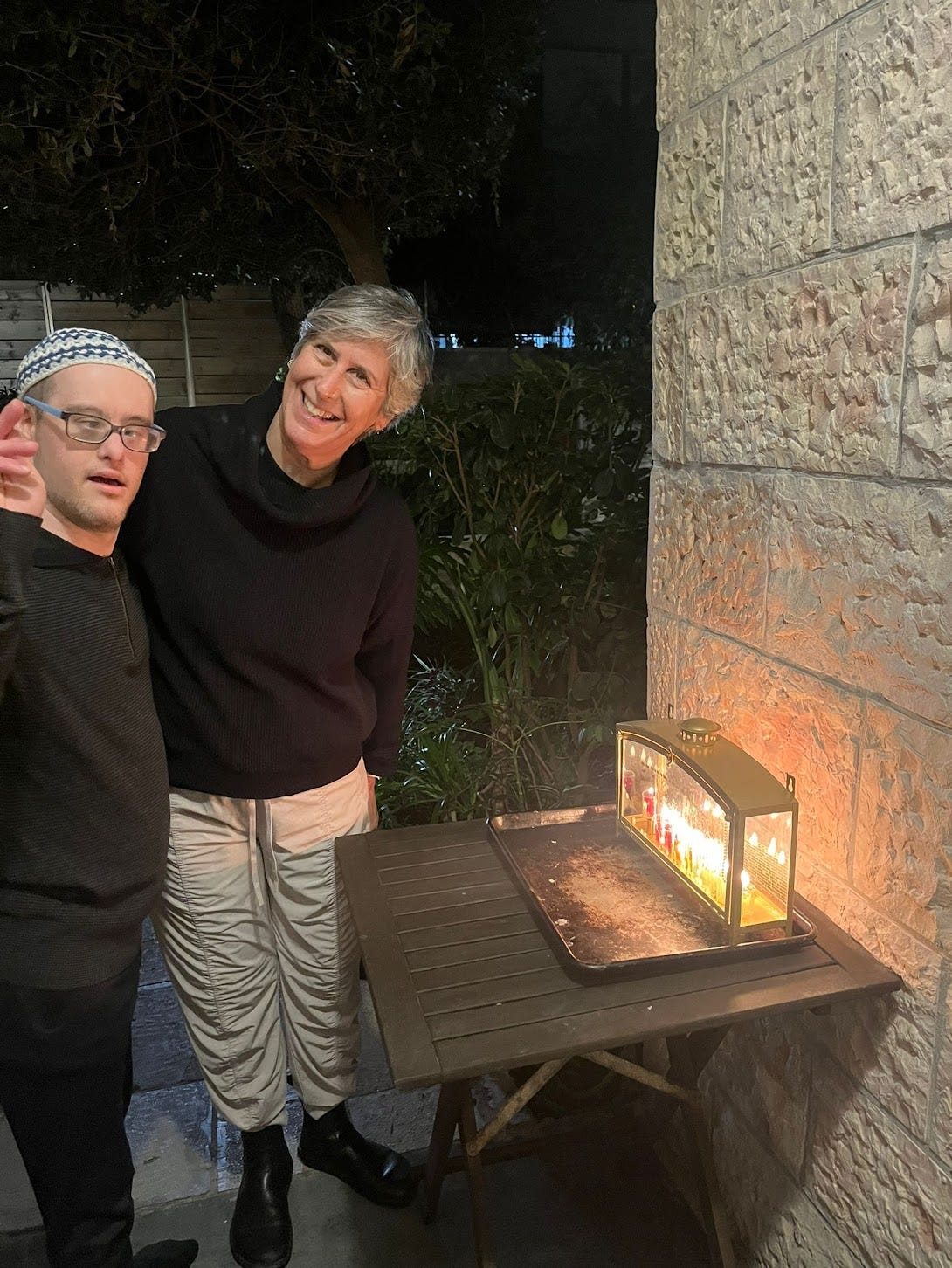
And if I’m brutally honest, as Akiva got older, I pulled back more and more. I find synagogue going complicated. He loves it but I don’t always love sitting next to him, as he chats, or sings, or does what he needs to do to be present in the space, even if that’s not completely connected to what’s going on. For those who don’t know Akiva, he’s an adult with cognitive disabilities. His synagogue needs are different than mine.
Truly, the best time for synagogue hopping was during COVID. In Jerusalem, every street had it’s own minyan, and given that all this prayer happened without the structure of a building, there was a feeling of ease in those prayer spaces in terms of the usual separation between men and women typical of Orthodox practice. Even our own building had a Friday evening group, and while yes it was a male-led service, we all stood outside our front doors - families standing together - singing lustily and supporting our need to gather in prayer as a community during a complicated time.
But back to the discussion that went awry in our synagogue community. It being Israel, it was on a self moderated community whatsapp group chat. In Israel, there is a whatsapp group for everything. It’s a drag but it’s how business gets done from your kid’s class groups to your local buy-nothing group to your synagogue groups, one for open conversation and one for announcements! (In our family alone there are the convos with each of our kids, with our kids and their partners, with each kid and their partner, with the extended family, etc.)
The conversation got spirited, even insulting. People paused to discuss the language being used, leaving aside the issue being analyzed. Some thought strong or even mean language wasn’t such a big deal, everyone’s allowed their opinion, while others thought we should strive for more kindness alongside our opinions. A very Israeli opinion - say it straight, say it out loud. Don’t worry about people’s feelings.
Things got so heated, that the community leader shut the group down for 6 hours. This was not a popular choice, and he navigated censure via heated phone calls, as well as in person talks in synagogue the following Shabbat.
What’s my point?
Nice language breeds nice language. Positive language yields positive thoughts about people, about situations, about expectations and about needs. Negative language? It puts people down and it creates bad feelings. Feelings that may not go away so quickly. Our words matter so much more than we really like to consider.
As someone who works in the disability field as co-founder of Shutaf Inclusion Programs in Jerusalem, I’m always amazed by the language used by parent advocates as well as those who assess, analyze and diagnose people with diverse needs and disabilities. The language of diagnosis, for example, rarely presumes competence. It’s all about deficits, so that a person can get the services they need on their “road to success,” whatever that really means.
What’s even worse is the affect of diagnosis language on parents, the first and most important ally in a person’s life. Words and labels, like high or low functioning, do not describe a person’s qualities or needs in a ‘holistic’ or positive fashion let alone descriptions like, “he’s 20 years old, but he’s cognitively a 5-year old.” When I hear a parent describe their child this way, or as low functioning, I cringe to think of the negative connotations of those words but it’s how the parent has been educated about their loved one. With negativity.
As opposed to how we hopefully began our lives. With positivity. With parents cheering us on as we moved from babyhood into childhood and beyond. Even if they were tired, or worried, just doing their best to make it through those early and often hard years of raising kids. At some point it seems, many of us become more hesitant, maybe as the cheering crowd who applauded every new skill quiets down, and our children, and the children we teach and serve, learn about failure, and to fear it. Especially in young adulthood, when we should encourage teens and young people to take risks and reach for the stars, we often change our tune and our positive attitude, and we talk about failure. We forget that only moments ago, we said, “if at first you don’t succeed, try, try, try again.”
Failure. Can’t we find a different word for the skills that are easier to access and those that are more complex? Or, accept that sometimes those things we want the most don’t quite work out they way we hoped and dreamed. My husband Ira’s co-worker, has a daughter who worked to become an Olympic figure skater. She worked hard and succeeded, but didn’t get to the Olympics. (Ira and I cheered her every win and admired her fancy costumes.) She learned skills most of us will never know, and now, at 20 is dealing with how things played out, what will her life be now, off the ice, as her body recovers from the effort of jumping off the ice and landing down…hard. But what a ride she had. What experiences. I’m proud of the work she put in and the skills she achieved. Who knows what will grow out of those very goals that eluded her, including winning important competitions, gaining those big jumps she worked on, and yes, getting to the Olympics.
Does this mean you can’t use the word failure? I’m not here to tell you what language to use or not use. That’s your call.
Our job as caring humans? To pause and think about what have we been told and what that really means…or not. To consider how to be a positive and empowering thinker with respectful, active, and accommodating language. Model it for yourself and see how others react around you. Create new possibilities for yourself and others.
#BringRanHome
#Peace
#FreeIran